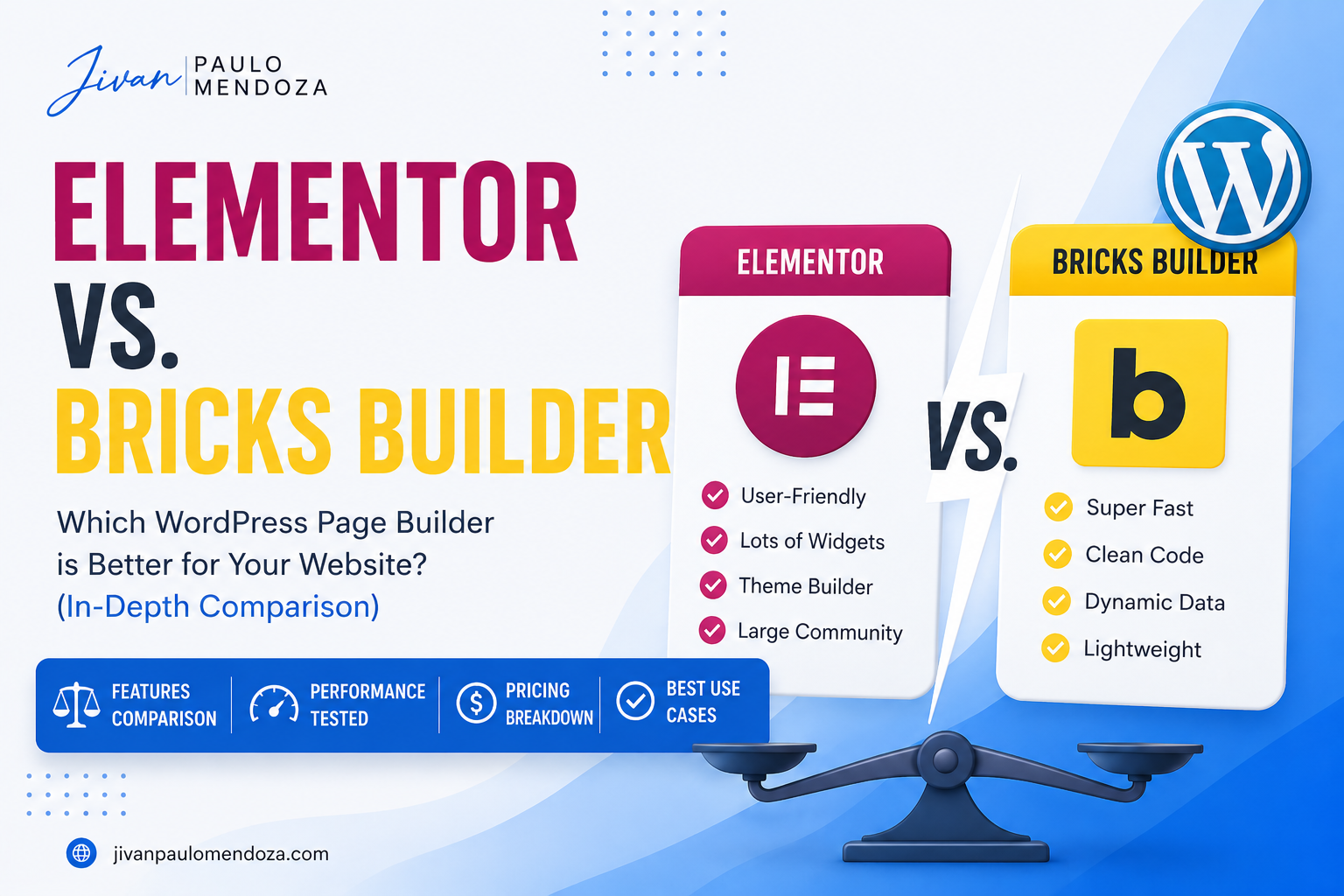
You’re building a new WordPress site and you’ve heard the buzz about Bricks Builder. Everyone in the WordPress community seems to be talking about it. But you’ve been using Elementor for years — or your developer has. Is it worth switching?
I’m Jivan Paulo Mendoza, and I’ve built sites professionally using both tools. I’m not sponsored by either. This is an honest, developer-level comparison to help you make the right call for your specific situation.
Short answer: both are excellent. The right choice depends on who’s building the site, your budget, and your long-term needs. Let me break it down.
First, a Quick Overview of Both
Elementor
Elementor launched in 2016 and essentially democratized WordPress design. It has over 12 million active installs and a massive ecosystem of third-party addons, templates, and integrations. Elementor Pro is the paid version that unlocks the full feature set.
Bricks Builder
Bricks is newer (launched 2021) and has quickly earned a cult following among developers. It’s a one-time lifetime license, it’s developer-friendly, and it produces cleaner code than most page builders. It’s grown explosively over the past two years and is now considered a serious professional tool.
Performance Comparison
This is where Bricks pulls ahead — and it’s the number one reason developers are switching.
Elementor has historically produced bloated code. The free version is particularly heavy. Pro is better, but Elementor still generates more DOM elements and extra CSS than necessary. It’s not terrible, but it takes deliberate optimization to get good Core Web Vitals scores.
Bricks generates considerably cleaner output. There’s less wrapper bloat, the CSS is scoped only to what’s used, and it plays better with performance optimization plugins. Building the same page in both, I consistently see 10–20 point PageSpeed differences in favor of Bricks.
| Developer note: If your site needs to score 90+ on PageSpeed for competitive SEO, Bricks is the more natural starting point. You can get there with Elementor too — it just takes more deliberate effort. |
Ease of Use
Elementor wins here, and it’s not close. Years of iteration have made Elementor’s interface intuitive even for non-developers. Drag, drop, adjust the settings in the right panel. Most clients who want to manage their own content can learn the basics in an afternoon.
Bricks has a steeper learning curve. The interface is excellent once you know it, but the structure (containers vs. elements, how styling inheritance works, dynamic data) takes time to internalize. For clients who want to edit their own sites, I always factor in extra training time or suggest sticking with Elementor.
Developer Experience
Bricks is built with developers in mind. It has:
- Proper PHP-based element registration (no hacks needed)
- Clean custom code integration — add CSS and JS directly to elements
- Query Loop builder that makes dynamic sites a joy to build
- Native integration with ACF, Metabox, and Pods
- Git-friendly structure for teams
Elementor has improved significantly for developers, but it still feels like a tool that was designed for non-developers first and extended for developers later. Bricks feels like it was designed for developers and made accessible to designers.
Pricing
| Elementor Pro | Bricks Builder | |
| Model | Annual subscription | Lifetime license |
| 1 Site | ~$59/year | $149 lifetime |
| Unlimited Sites | ~$399/year | $249 lifetime |
| Free Version? | Yes (limited) | No |
| Addon Ecosystem | Massive | Growing fast |
Bricks wins on long-term cost, especially for agencies building multiple sites. The lifetime license pays for itself quickly.
Which Should You Choose?
Choose Elementor if:
- You or your team will be editing content regularly and need an intuitive interface
- You need a massive template library to work from
- You rely heavily on third-party addons (JetElements, Essential Addons, etc.)
- You’re migrating an existing Elementor site — don’t switch mid-project
Choose Bricks if:
- Performance and clean code are a top priority
- Your developer is comfortable with a steeper learning curve
- You’re building complex dynamic sites with ACF or custom post types
- You want to avoid ongoing subscription costs (lifetime license)
- You’re building a new site from scratch with an experienced developer
My Personal Take
I use both, depending on the project. For clients who want to manage their own site, I reach for Elementor because training time matters. For performance-critical projects or complex custom builds where I’m doing most of the development, Bricks is my preference — the code quality and developer experience are genuinely better.
The WordPress ecosystem is healthy enough that you can’t make a “wrong” choice here. What matters more than the tool is the developer building with it.
| Need a WordPress developer? I help businesses build, optimize, and maintain high-performance WordPress sites. If you have a project in mind, I’d love to hear about it. → Start a project: jivanpaulomendoza.com/#contact |